
You don’t need special materials. You don’t need to prepare anything.
Just look around. Choose an everyday object — the most ordinary one, the one that’s always there and that you almost don’t see anymore.
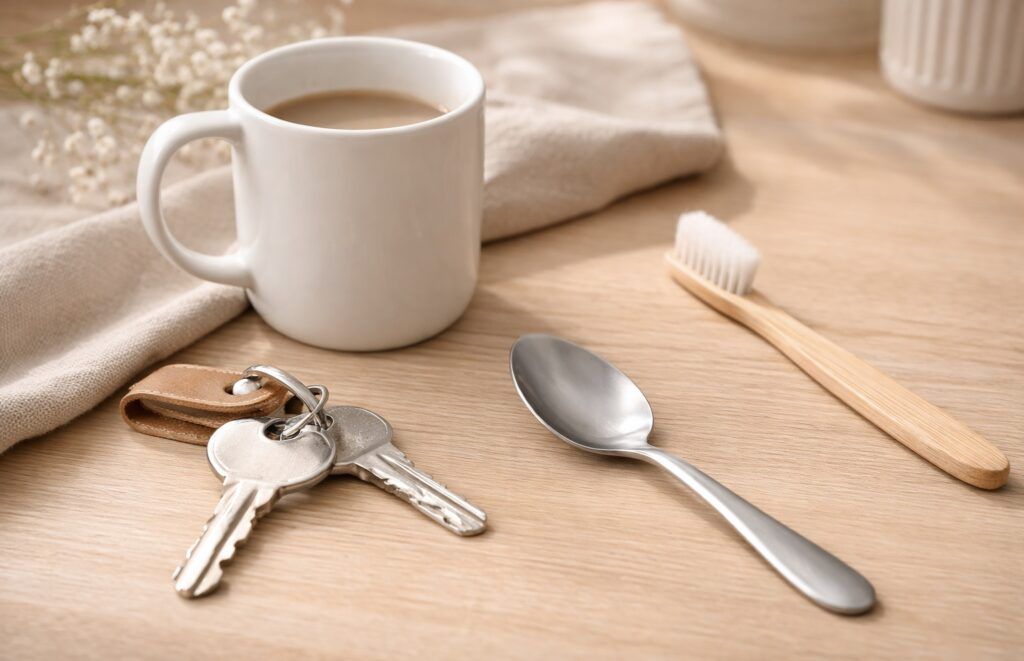
It could be a mug, a key, a spoon, or a pencil. Today, we’re going to play with it.
Change the name to change the way you see it
That object is tired. Tired of being called the same thing. Tired of doing what it’s meant to do. Let’s give it a holiday and give it another name instead. An absurd one.
One that doesn’t match what it represents. One that makes you smile and wonder whether you’ve slightly lost a screw somewhere along the way.
- The spoon could become a silver racket.
- The key could become a metal jewel.
- The mug could become a porcelain hat.
Don’t explain why. Just look at it again. Is it still exactly the same?
Sometimes creativity with simple objects begins like this — by changing a single word.
The Italian writer Gianni Rodari spoke about this in The Grammar of Fantasy: when we bring together things that don’t usually belong together… something wakes up.
That’s what we’re doing here. Waking up perception. This creative game with an everyday object is a simple way of practising intuitive vision at home.
An exercise also used in intuitive vision: switch hands
Now let’s take it one step further. If you’re right-handed, use your left. If you’re left-handed, use your right.
Pick up the object with your non-dominant hand. Move it. Turn it. Place it somewhere else.
If you feel like it, try doing more things today with that hand: opening a door, writing a word, brushing your teeth.
Not to do it perfectly. To feel.
The “clumsy” hand forces you to pay attention. The movement slows down. Your gaze becomes more present. And suddenly, something simple begins to change.
Dr. Joe Dispenza often points out that when you do something new — like brushing your teeth with your non-dominant hand, changing your routine, or learning a new skill — you’re nudging the brain out of autopilot. This activates neural circuits you don’t usually rely on and may help create or strengthen new synaptic connections.
This small exercise, also applicable to intuitive vision, can be done at home in less than five minutes. And yes — it works. (If the coffee spills, the blog takes no responsibility…)
It’s not the object. It’s you.
We’re not trying to become more creative. We’re loosening habit. As we saw in Simple Materials, Infinite Possibilities, you don’t need anything extraordinary to shift your perception. An everyday object can become something new. And so can you.
And then…
We haven’t done anything extraordinary. We’ve just renamed a spoon and used the “wrong” hand. And yet, something moved.
Maybe imagination doesn’t need big plans. Just small acts of mischief.
Tomorrow the object will go back to being what it was. Although you and I both know… it might not be exactly the same. And that changes quite a lot.